Rivoli Bluff: A History
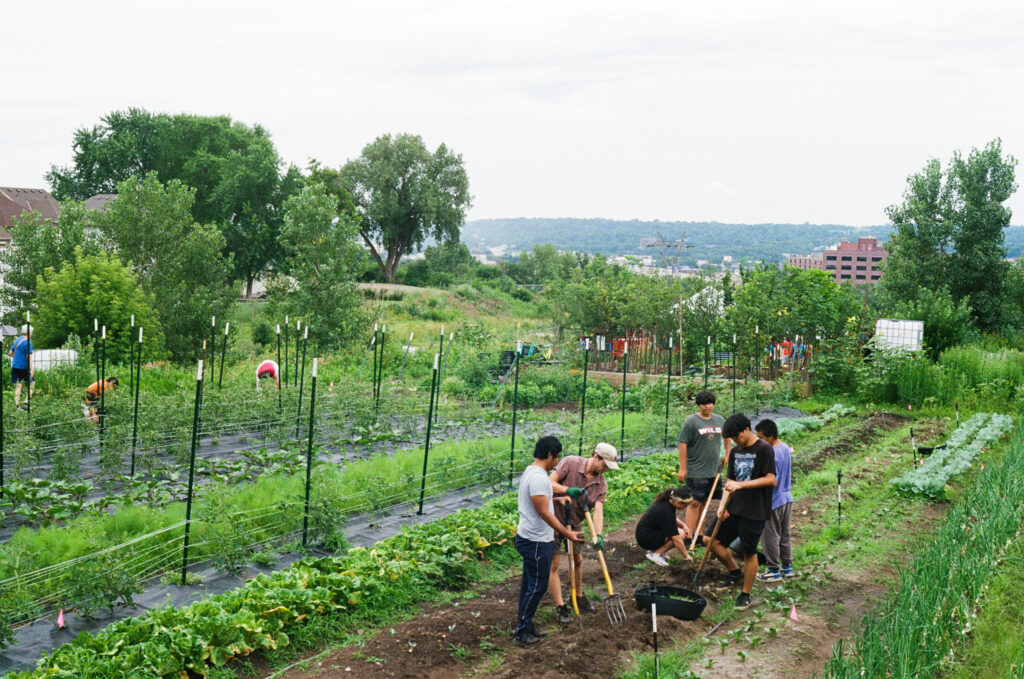
Rivoli Bluff Farm and Restoration Site is the largest site managed primarily by Urban Roots, and has been a central focus of both the conservation and market garden programs since it came under our management in 2016. Located on a bluff overlooking what was once the Trout Brook Valley, this was for decades the dump site for street sweeping and snow-removal waste for the city. After chemical remediation, Urban Roots has worked to establish two fruit tree orchards, a community garden, pollinator and rain gardens, restored savanna ecosystems, beehives, an educational children’s garden, extensive vegetable growing plots, and an Indigenous medicine garden planted by our partners at Wakáᶇ Tipi Awaᶇyaᶇkapi.
- Time immemorial– The land that is now Rivoli Bluffs is likely an oak savannah overlooking the lush valley formed by Trout Brook.
- 1847- Land prospector Benjamin Brunson plans the neighborhood “Brunson’s Addition” on the bluff overlooking Trout Brook for its “pleasing views,” which would become the site of numerous victorian mansions before encroaching railroads made it a less desirable location. (Railroad Island | Saint Paul Historical)
- 1890s-1950s– Railroad construction encircles the neighborhood near what is now Rivoli Bluff, giving the neighborhood the nickname of “Railroad Island.” Air- and noise pollution from the railyards make this neighborhood an environmental justice community, and the city begins dumping street waste on the land that is now Rivoli Bluff Farm and Restoration Site. The forested area below the bluff is known as a refuge for “transients.” https://www.twincities.com/2015/05/09/railroad-island-to-be-st-pauls-biggest-housing-development-in-decades/
- 1927– First flight out of St. Paul Downtown Airport takes off for Chicago. The flight path to and from the airport goes directly over what is now Rivoli Bluff, making urban development there unfeasible under zoning restrictions. https://metroairports.org/about-us/our-history
- 1960s– Dayton’s Bluff Neighborhood Housing Services creates plans for a housing development in Railroad Island, which would include the land that is now Rivoli Bluff. https://www.twincities.com/2015/05/09/railroad-island-to-be-st-pauls-biggest-housing-development-in-decades/
- 1970s– The state builds I-35 north through the Trout Brook Valley, following the path of the old St. Paul and Duluth railroad. Street sweeping waste from the construction is deposited on the bluff overlooking the valley, which becomes a primary dumping ground for the rest of the city’s street sweeping, as well as an informal dumping ground for the neighborhood. This is the site of today’s Rivoli Bluff Farm and Restoration Site. https://www.twincities.com/2015/05/09/railroad-island-to-be-st-pauls-biggest-housing-development-in-decades/
- 1995– City stops using Rivoli Bluff as a street sweeping dump site, which is labeled a Brownfield site. https://www.twincities.com/2015/05/09/railroad-island-to-be-st-pauls-biggest-housing-development-in-decades/
- 2008– with funding from a Brownfield site grant, the city conducts a $2.7 million cleanup of Rivoli Bluffs. https://www.twincities.com/2015/05/09/railroad-island-to-be-st-pauls-biggest-housing-development-in-decades/
- 2016– Construction begins on housing development at Rivoli Bluff. DBNHS asks Urban Roots to help develop the unused land (which is in the flight path of the downtown airport, and so undevelopable) into a market garden and orchard. https://www.twincities.com/2015/05/09/railroad-island-to-be-st-pauls-biggest-housing-development-in-decades/
- 2017-2023– Rivoli Bluffs becomes the central worksite for the market garden and conservation programs. The garden program begins by creating a large garden plot below the hill, adding the hoop house, and planting the orchard. Youth Council decides to build community garden plots, and another vegetable plot is built on top of the hill in 2021. Conservation related work on this site includes installing pollinator and rain gardens, mushroom logs, gravel bed, apiary, Indigenous medicine garden (in partnership with Lower Phalen Creek Project), and oak savanna restoration
Farm Director Skyler Hawkins worked with Gaston (Chip) Small, a soil scientist at the University of Saint Thomas, to create a “Life of Rivoli Bluff” profile exploring the challenges and opportunities posed by using the Rivoli Bluff Farm and Restoration Site for urban agriculture. Check out the video below.